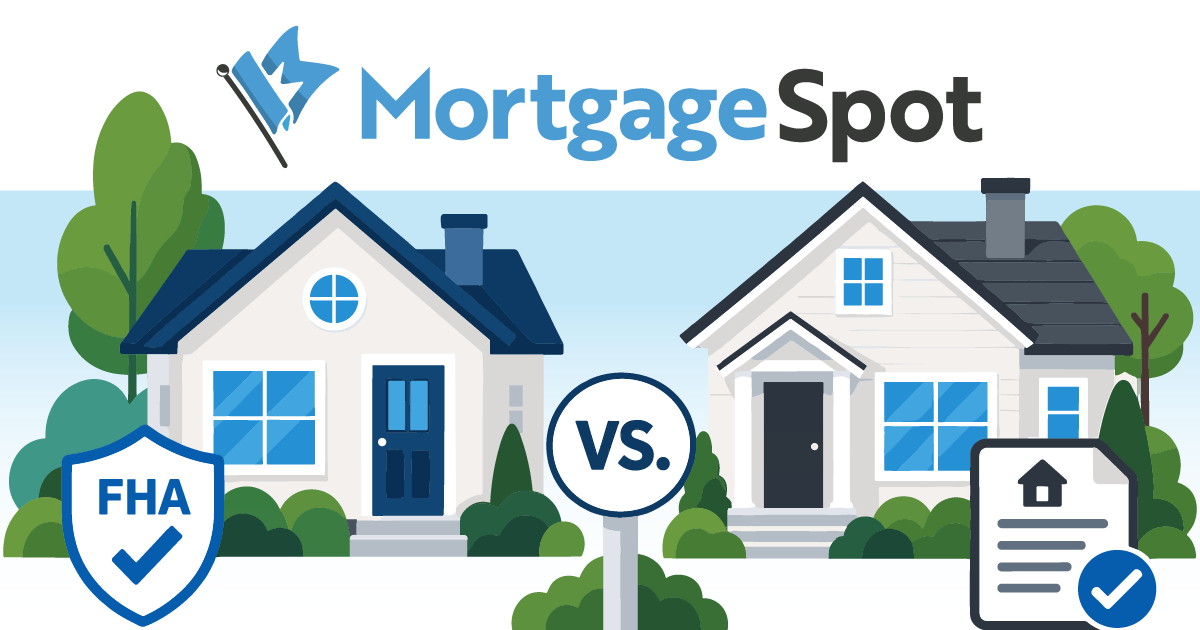
The Mortgage Spot team is asked this comparison quite frequently, and the honest answer is that neither loan is “better.” They’re built for different buyers, and figuring out which buyer you are takes about five minutes.
The 30-second comparison
| FHA | Conventional | |
|---|---|---|
| Minimum down | 3.5% | 3% |
| Credit guidelines | More forgiving | Stricter |
| Mortgage insurance | MIP, usually for the life of the loan | PMI that can be removed at 20% equity |
| Usually best for | Buyers still building credit or savings | Strong credit, lowest long-term cost |
The table above gives a quick overview of the key differences between the two programs. The rest of this post explains each criteria in more detail to help you decide which column fits best.
Where FHA wins
FHA loans are insured by the Federal Housing Administration, and that government backing may let lenders say “yes” in some situations where conventional guidelines might say “not yet.”
If your credit file is thin, if you had a rough stretch a few years back, or if your score sits below where conventional pricing gets friendly, FHA is often the door that’s actually open. The guidelines genuinely look at your whole picture rather than holding a single number against you.
The down payment is 3.5% for qualified buyers, and it can come from savings or eligible gift funds. For a lot of first-time buyers in Oklahoma and Kansas, that combination of forgiving credit and a modest down payment is what turns “someday” into a closing date.
The trade-off has a name: Mortgage Insurance Premium or MIP. FHA loans have mortgage insurance premiums, an upfront premium that’s usually financed into the loan plus a monthly amount in your payment. And unlike conventional PMI, MIP typically sticks around for the life of the loan. That’s the price of the easier front door.
Where conventional wins
Conventional loans reward strong credit and income history. If your credit is established and your finances are steady, conventional usually delivers the lowest total cost of ownership, and the reason is what happens to mortgage insurance.
Put less than 20% down on a conventional loan and you’ll pay Private Mortgage Insurance (PMI). But here’s the part that matters: PMI can be removed. Once you reach 20% equity, through payments, appreciation, or both, it can be removed from the loan and your monthly payment.
Conventional also starts at just 3% down for qualified buyers, which surprises people who assume FHA is automatically the low-down-payment option. It isn’t. The real difference between the two is credit flexibility and how the insurance behaves, not the down payment.
The crossover point
Picture two buyers purchasing the same house.
- The first has an excellent credit score and 5% down. Conventional almost certainly wins: better pricing for strong credit, and PMI that disappears in a few years.
- The second has a fair credit score and 3.5% down from a family gift. FHA likely wins: the guidelines are more accomodating for the applicant, and the pricing may be friendlier than conventional’s.
In between those two buyers is a crossover zone, where the answer requires running your actual numbers both ways.
One more fact worth knowing: Starting with an FHA loan doesn’t mean you have to keep the FHA loan for life. Plenty of buyers start FHA, build equity and credit for a few years, then refinance into a conventional loan and drop the MIP. Starting with the loan that gets you in the door, then upgrading later, is a completely legitimate strategy.
You don’t have to decide alone
Here’s the part that should take the pressure off. You don’t pick your loan in a vacuum, and you don’t have to get it right before you talk to anyone.
Tell a loan officer your situation, and we can show you the comparison in real dollars: down payment, monthly payment, insurance behavior, total cost over the years you plan to stay. Every buyer’s favorite moment in that conversation is realizing the decision was never as complicated as the internet made it look.
If you want to read deeper first, both product pages go further: FHA loans in Oklahoma and conventional home loans in Oklahoma, including current guidelines and answers to the questions we hear most.
Frequently asked questions
Can I refinance from FHA to conventional later?
Yes, and it’s a common path. As your equity and credit grow, refinancing to conventional can remove mortgage insurance and lower your total cost.
Which loan closes faster?
In practice they run on similar timelines, typically a few weeks from accepted offer to closing. FHA adds an appraisal with slightly stricter property standards, which occasionally adds a step, but a well-prepared file closes on schedule either way.
Which needs less money down?
Conventional, narrowly: 3% versus FHA’s 3.5% for qualified buyers. Both allow eligible gift funds. The bigger difference between the loans is credit flexibility and how the mortgage insurance behaves over time.
Not sure which side of the crossover you’re on? A loan officer can help you decide which option is best.